On 28 October the Reserve Bank of New Zealand's Monetary Policy Committee voted 4–3 to hold the Official Cash Rate at 2.75%, with three members preferring a 25 basis point increase to 3.0%. ASB had put the market-implied odds of a hike at around 95% before the announcement (as reported by NZ Adviser); BNZ's research team said it was "frankly flabbergasted". The same day the US Federal Reserve held its target range at 3.75–4.00% by 10 votes to 2, with both dissenters, Lisa Cook and Beth Hammack, preferring an increase. On 4 November Stats NZ reported that New Zealand's unemployment rate rose to 5.7%; Westpac noted it is the highest since September 2015. On 6 November the US Bureau of Labor Statistics reported that nonfarm payrolls rose by 165,000 in October, against a Dow Jones forecast of 59,000. And on 7 November New Zealand voted, and woke up to a result that does not yet say who governs.
None of those prints is a rate rise. Together they define the pause wholesale investors are now standing in: the RBNZ has stopped, the Fed has stopped, and the labour data in the two countries point in opposite directions. In October we wrote that the four major banks all picked a hike to 3% on 28 October, and that for assets which already carry their income in the lease the direction mattered more than the date. The RBNZ did not hike, and we did not call it. The direction has not changed: the Committee said in the same breath that tighter policy "is likely to be required".
This edition covers:
- The pause: why the RBNZ held on 28 October, what the Committee said would change its mind, and where the banks now expect the OCR to peak
- The US: a Fed that held with two votes to hike, and a payrolls print that did not need the pause to be good news
- New Zealand's two open questions: an 11-year-high unemployment rate, and an election whose official count on 27 November will shape, but may not settle, who governs
- Singapore: no new MAS decision since 14 October, a rising local base rate, and what that means for freehold
- What a pause means for the income-versus-yield arithmetic across NZ industrial and Singapore commercial property
- Three new listings on the market this month: a Crown-leased industrial holding in Auckland and two Singapore commercial buildings, each large enough to need a syndicate
1. The Pause: Why the RBNZ Held, and What Would Change Its Mind
The Committee's media release gave the headline reasons. Annual CPI inflation was 3.7% in the September quarter, down from 4.1% in June and lower than expected; wage growth has been subdued and medium-term inflation expectations stable. But core inflation measures have risen to around the top of the 1 to 3 percent target band, and the Committee noted that 56% of the items in the CPI basket, on a weighted basis, rose by more than 3% in the year to September. The RBNZ now expects annual inflation to climb to 4.4% in the December quarter, largely on current fuel futures prices, and notes that the trade-weighted New Zealand dollar has fallen by around 3% since the September Statement.
The split was not about direction. It was about timing and risk. Anna Breman, Carl Hansen, Prasanna Gai and Rebecca Williams favoured a hold: inflation had been lower than expected, the indirect effects of fuel prices smaller than feared, and they stressed the risk of a weak recovery in household consumption and investment. Paul Conway, Hayley Gourley and Karen Silk favoured an immediate 25 basis point rise to 3.0%, on the grounds that core inflation has been above target-consistent levels for some time and that acting now would reduce the risk of needing to do more later. The Committee's own summary was that members "agreed that tighter monetary policy is likely to be required but remains conditional on the economic outlook". The Record of Meeting adds that information arriving over the next six weeks "could meaningfully change the appropriate policy stance in either direction", including, if the world economy turned sharply down, towards easing.
The street's response was to keep the direction and soften the date. On their own post-decision notes, ANZ (28 October, reaffirmed 4 November) expects three 25 basis point increases, in December, February and March, taking the OCR to 3.50%; BNZ (28 October) expects a rise on 9 December and a 3.75% peak; Westpac (28 October) expects a December rise and a peak of 4.00% in September 2027; Kiwibank (29 October) expects 3.00% and then 3.25% in 2027. ASB also expects December, February and March to 3.50%, and NZIER just one more increase, in late 2027 (both as reported by NZ Adviser). Even the bulls hedged. Westpac wrote on 28 October that even the December rise it forecasts "should not be regarded as a done deal", and after the labour data its economists called it "far from a done deal"; Kiwibank's view is that a December rise is "more likely than not". NZ Adviser reported on 9 November, citing Westpac and BNZ, that market pricing implied a 60 to 65% chance of a rise on 9 December, and that the two-year swap rate had fallen by about 40 basis points from its level before the hold, to around 3.7%.
The RBNZ has told the market the direction again. What it has not told the market is the date. For an asset that carries its income in the lease, the difference between a December rise and a February rise is a financing question, not an income question.
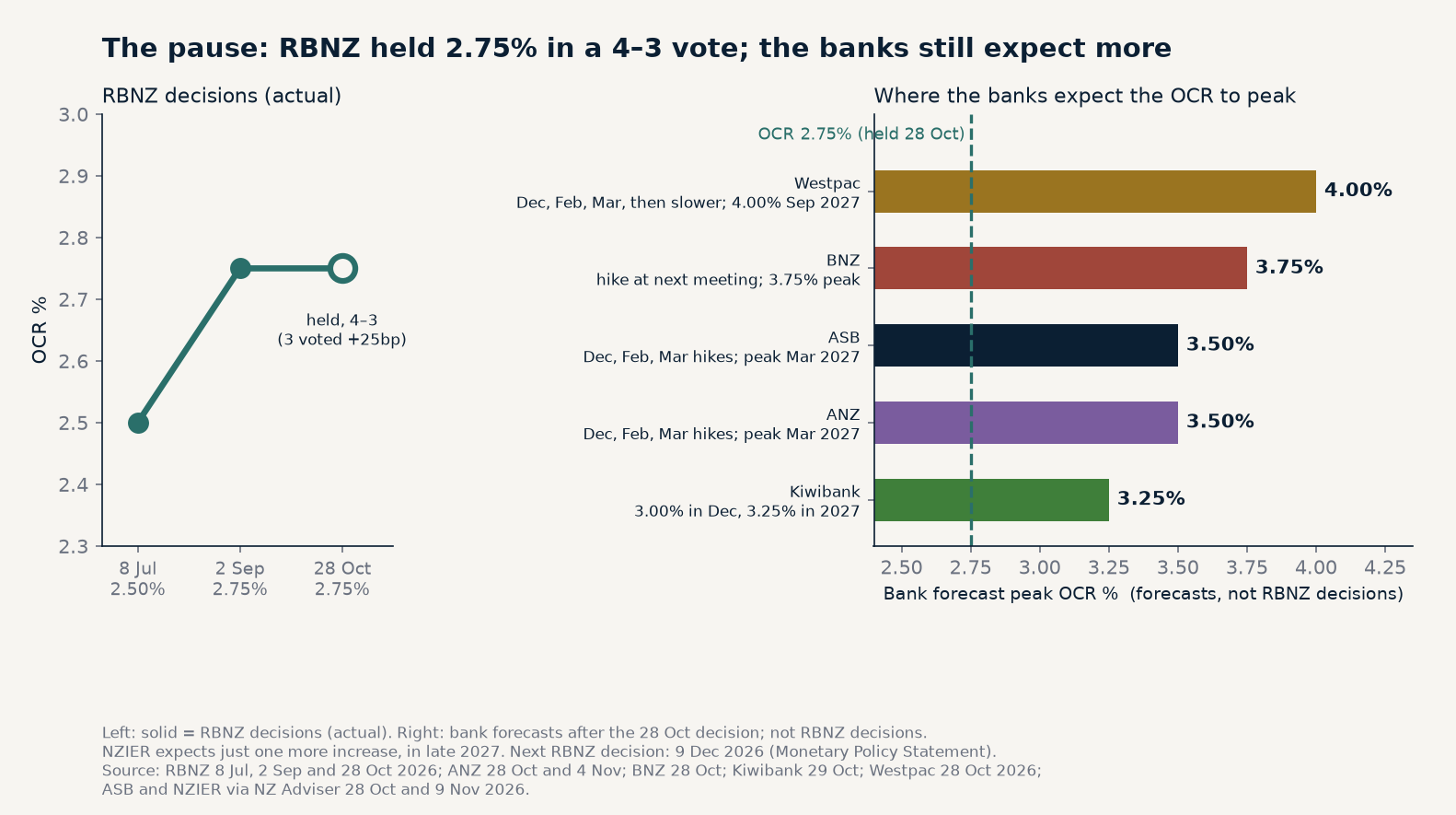
Source: RBNZ 8 Jul, 2 Sep and 28 Oct 2026; ANZ 28 Oct and 4 Nov; BNZ 28 Oct; Kiwibank 29 Oct; Westpac 28 Oct 2026; ASB and NZIER via NZ Adviser 28 Oct and 9 Nov 2026. Bank paths are forecasts, not RBNZ decisions. The next decision is the Monetary Policy Statement on 9 December.
2. The US: A Fed on Hold With Two Votes to Hike
The Federal Open Market Committee's 28 October statement kept the target range at 3.75–4.00%, where it has been since the quarter-point increase of 16 September. The text was mostly unchanged, with one notable upgrade: "Economic activity is expanding at a strong pace", replacing "solid". It also said that "Inflation remains elevated", and closed with "The Committee will deliver price stability." Two members, Lisa Cook and Beth Hammack, voted against the decision because they preferred to raise the range by a quarter of a percentage point. In his press conference Chairman Kevin Warsh said the third quarter appeared to have brought an even more rapid advance than the first half, led by healthy consumer spending, "likely running above 3 percent growth", and business investment "likely rising at about a double-digit pace".
The labour data on 6 November was consistent with that description. The BLS reported nonfarm payroll employment up 165,000 in October, against an average monthly gain of 48,000 over the prior 12 months and a Dow Jones forecast of 59,000. The unemployment rate fell to 4.1% from 4.2%, and average hourly earnings rose 0.4% on the month for a 3.1% annual increase. Earlier months were revised up: August to 186,000, September from 29,000 to 60,000. In October we wrote about a payrolls miss that did not reopen the easing conversation. November's print closes it further: the signal investors on the sidelines were waiting for, a US turn to easing, has not arrived, and two members of the Committee wanted to go the other way.
For New Zealand and Singapore commercial property the transmission pipe is the same as in every edition since August: long-end yields, the US dollar, and the ceiling on the global rate headwind. The RBNZ itself pointed to it on 28 October, noting that global long-term interest rates have increased and that some central banks have raised policy rates. The FOMC next meets on 8–9 December; its statement lands a day after the RBNZ's Statement in New Zealand time.
Investors waiting for the US to turn before committing to income assets are waiting for a committee in which two members, at its last meeting, wanted to raise rates.
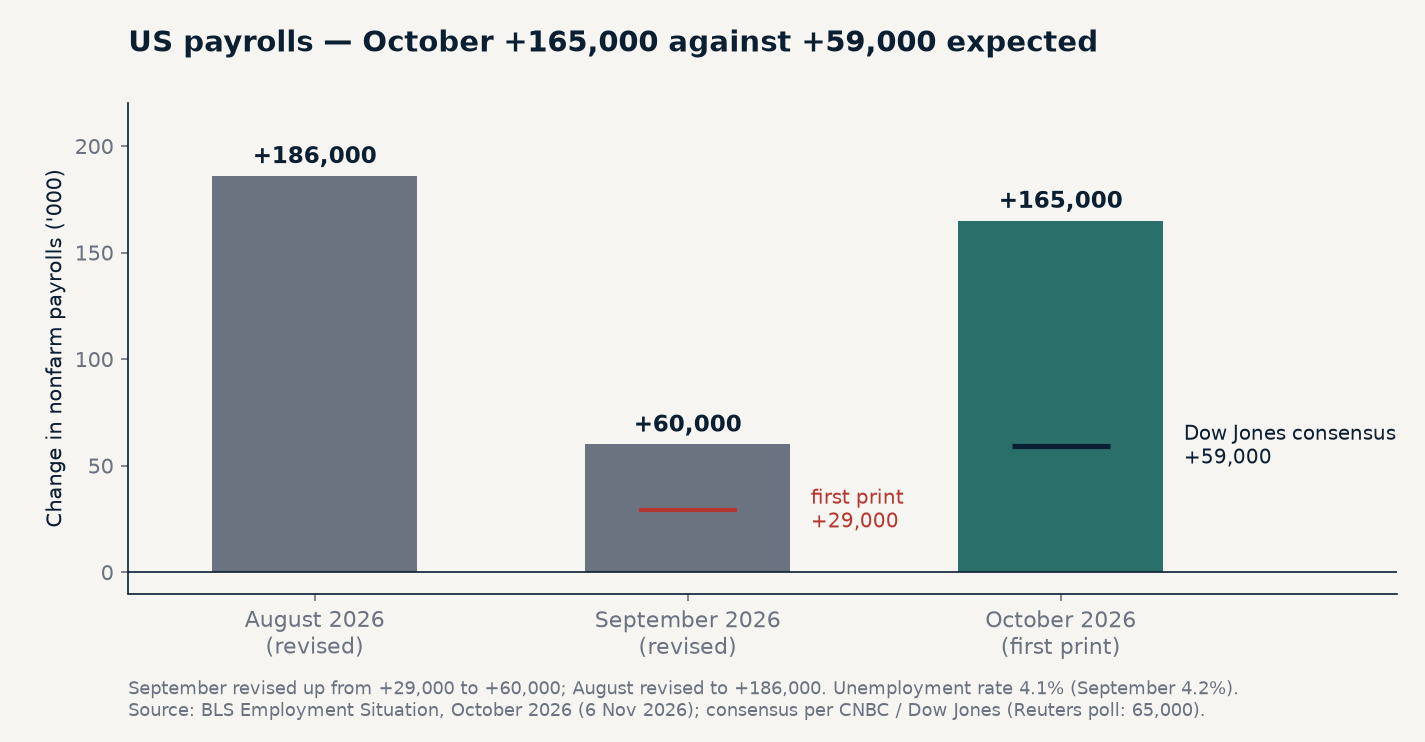
Source: BLS Employment Situation, October 2026 (6 Nov 2026); Federal Reserve FOMC statement 28 Oct 2026 and Chairman's press conference transcript 28 Oct 2026; CNBC 6 Nov 2026 (Dow Jones consensus). A Reuters poll had expected 65,000.
3. New Zealand's Two Open Questions: Jobs and a Government
Jobs. Stats NZ's September-quarter labour market statistics, released on 4 November, put the unemployment rate at 5.7%, up from 5.6% in June (the highest since September 2015, on Westpac's reading), against economist expectations of a flat or lower outcome (The Post). Employment was 2,891,000 against 2,896,000 in June, the employment rate eased to 66.4%, and underutilisation held at 13.8%. Annual wage inflation, as measured by the labour cost index, was 2.1% (2.0% in June). Westpac's reading was that the data were weaker than the RBNZ had expected, and wrote that "This data supports the views of those on the policy committee who were less convinced in October about the potential for second-round inflation pressures in the economy". ASB's acting chief economist Kim Mundy said there was "clearly still a lot of slack in the market" keeping a lid on wages. The RBNZ's own words a week earlier were that employment intentions "remain weak".
A government. New Zealand voted on 7 November. The Electoral Commission's preliminary count projects 131 seats: National 42, Labour 36, Greens 16, ACT 13, NZ First 12, the Opportunity Party 7 and Te Pāti Māori 5. National and its partners ACT and NZ First are on 67 seats; 66 are needed for a majority in an enlarged parliament. National and Labour each polled below 30% of the party vote, the lowest combined level since at least 1996 (Reuters). The preliminary figures are indicative: about 400,000 special votes are still to be counted, and the Commission expects to publish the official results on Friday 27 November.
Westpac's bulletin of 9 November is the most careful read of the arithmetic. It argues that National might lose perhaps two marginal electorates, and that special votes tend to reduce the centre-right bloc's share, so the bloc's 10-seat lead on election night could shrink by 1 to 4 seats, in which case it would need the Opportunity Party's support to govern. It also notes that a centre-right government would not change the RBNZ's mandate while a centre-left government likely would, and that serious coalition negotiations are unlikely to begin before 27 November. ANZ's view, as reported by NZ Adviser, is that neither major party's fiscal plan would materially change its economic or OCR outlook for now. We do not forecast the result. The point for an investor is the calendar: the official count and the RBNZ's Statement fall twelve days apart, so the Committee will set the OCR while coalition talks are still young.
Two questions are still open: who governs, which the official count on 27 November will shape but may not settle, and what the Committee does on 9 December. Neither changes what a signed lease pays.
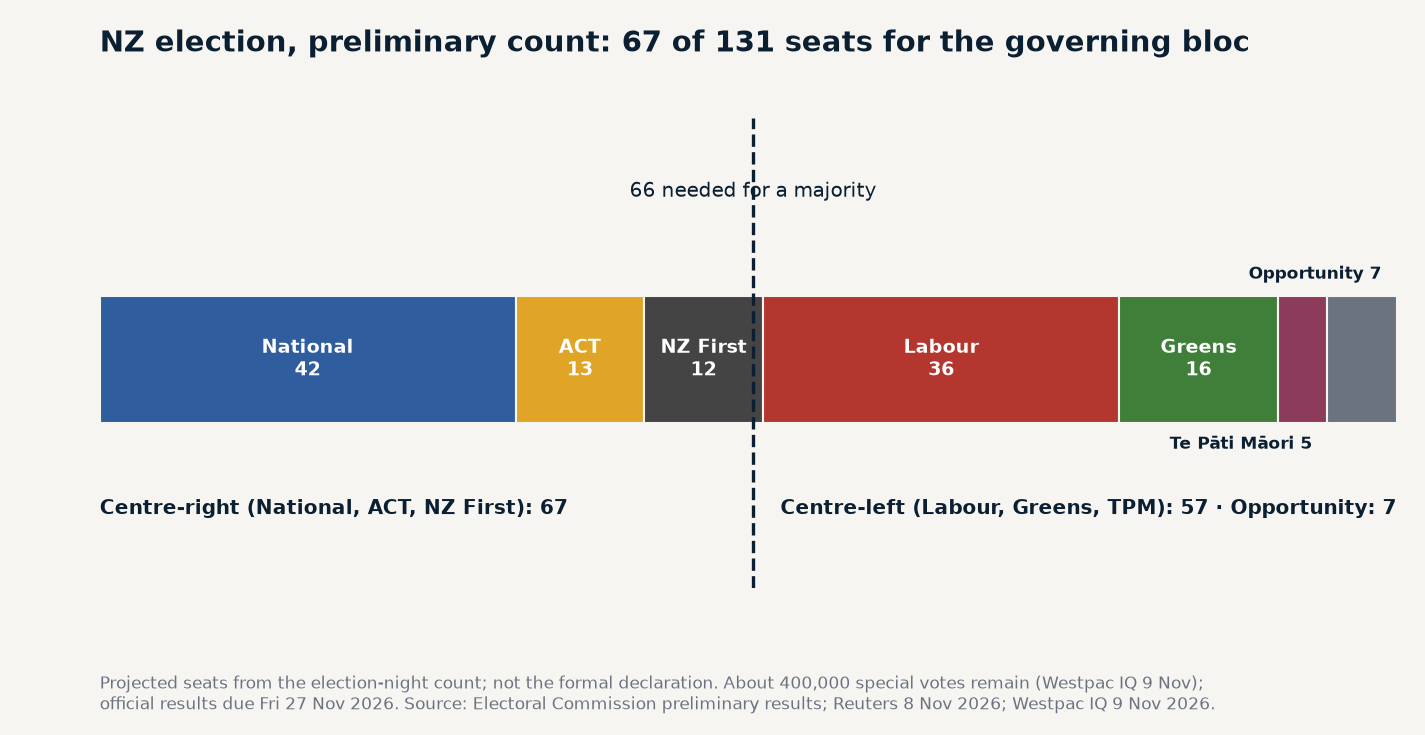
Source: Electoral Commission, 2026 General Election preliminary results (8 Nov 2026) — not the formal declaration; official results expected Friday 27 November 2026; Reuters 8 Nov 2026; Westpac IQ economic bulletin 9 Nov 2026.
4. Singapore: A Quiet Month for MAS, a Firmer Base Rate
MAS does not set an interest rate. It sets a path for the Singapore dollar nominal effective exchange rate, the S$NEER, inside an undisclosed policy band, and adjusts the band's slope, width and centre at scheduled reviews. On 14 October it maintained the rate of appreciation of the policy band, with no change to the width or the centre, although every analyst in a Reuters poll had expected it to tighten. There has been no MAS decision since, and its next Monetary Policy Statement is due by 29 January 2027.
The market has moved in the meantime. Three-month compounded SORA, the benchmark for SORA-linked Singapore property loans, was 1.3241% on the 6 November publication, up from 1.2325% on 6 October, and 1.2568% on 23 October when we last reported it. That is a lift of about 9 basis points in a month, and it has risen every month since April, when it was 1.0182%. It is still less than half the RBNZ's OCR, and about 2.4 percentage points below the bottom of the Fed's target range, so local money has not become expensive. It is, however, moving in the same direction as borrowing costs in the other two economies we cover.
The data MAS and the Ministry of Energy, Trade and Industry (METI) released in October still frame the picture. Core inflation was 2.0% in September and headline 2.2%. The Ministry of Energy, Trade and Industry's advance estimate put third-quarter GDP 5.4% higher than a year earlier and 1.1% higher than the previous quarter on a seasonally adjusted basis. URA reported on 23 October that Central Region office rents rose 0.8% in the third quarter, prices rose 0.8% and island-wide office vacancy eased to 10.0% from 11.0%.
Singapore tightens by letting its currency rise. Its borrowing costs have started to follow, slowly. On our reading, that still leaves freehold a store-of-value trade with cheap local debt, not an income story.
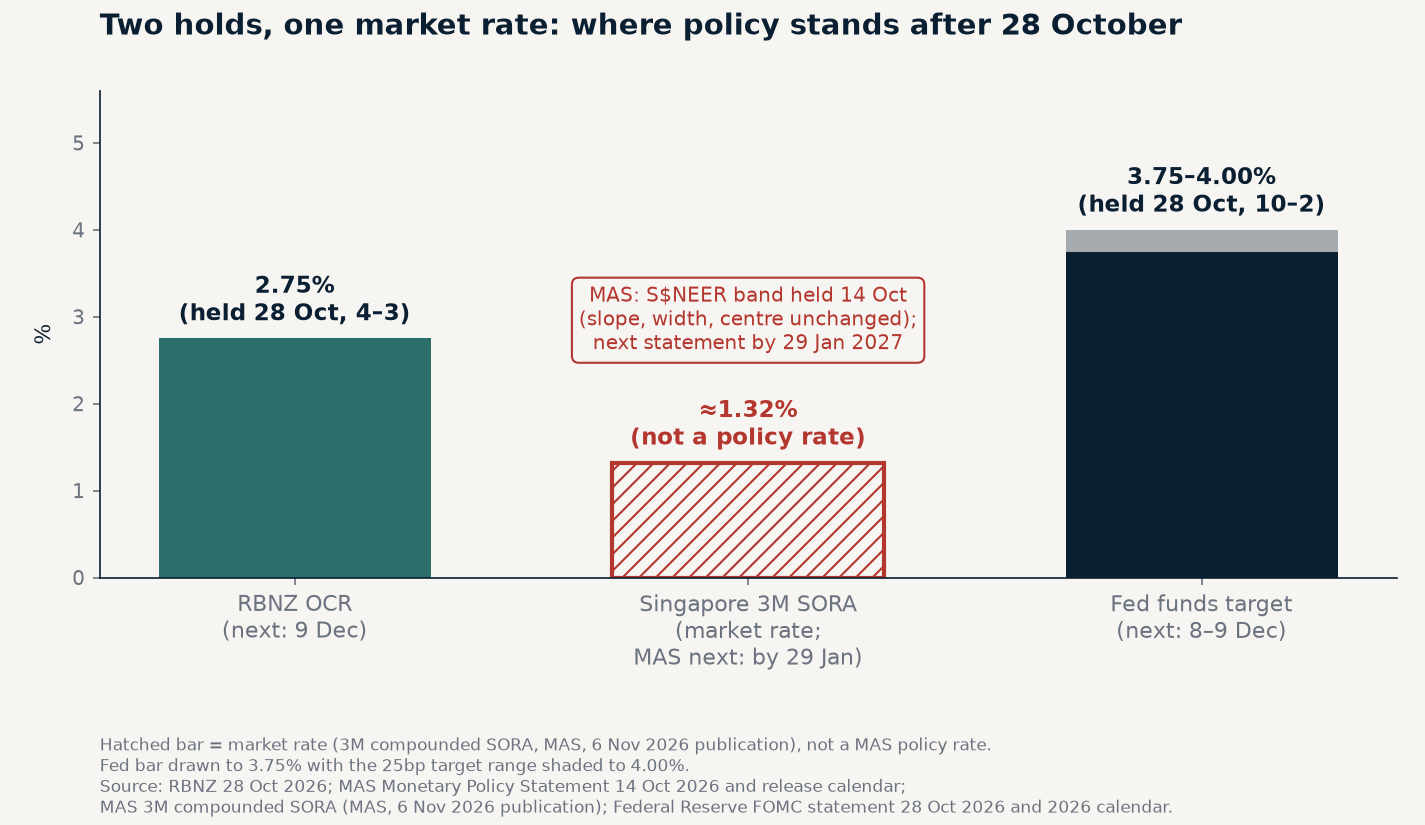
Source: RBNZ 28 Oct 2026 / MAS Monetary Policy Statement 14 Oct 2026 and MAS 2027 release calendar / MAS 3-month compounded SORA (MAS, 6 Nov 2026 publication) / Federal Reserve FOMC statement 28 Oct 2026 and 2026 FOMC calendar / MAS–METI Consumer Price Developments in September 2026 (23 Oct 2026) / METI advance GDP estimates 14 Oct 2026 / URA 3Q2026 statistics 23 Oct 2026.
5. Translate Into Commercial Property: What a Pause Does to the Arithmetic
A pause is not a cut. The peak the banks expect, 3.25% to 4.00%, is still above where the OCR is today, and the people who set mortgage and wholesale funding costs have not been told the date either. NZ Adviser reported on 9 November that two- to five-year fixed mortgage rates sit above 5% (Westpac), and that wholesale rates had fallen since the hold. For a wholesale investor the pause is a financing question: it changes the cost of leverage over the next six months far more than it changes the rent roll.
The income side of the arithmetic has not moved. JLL's September review has prime Auckland industrial trading at 5.00% to 5.50% and Christchurch at 5.75% to 6.50%. CBRE's Q3 2026 Asia Pacific cap rate survey (September figures) puts indicative cap rates for Singapore Grade A offices in core locations at 3.25% to 3.80%, unchanged from March. Midpoint to midpoint, that is a gap of roughly 170 basis points against Auckland and 260 basis points against Christchurch. That gap is the reason the two markets are different trades. New Zealand pays for the risk in income. Singapore pays in tenure, scarcity and, for a foreign syndicate, the removal of a tax that rules out most of the residential market.
The RBNZ gave a reason to think the income side is supported rather than threatened. It said the economy "continues to recover", with export-exposed regions "benefiting from high commodity prices, strong demand for goods exports and increased tourist numbers", and that there are "some early signs of a recovery in residential investment, including in Auckland". It also said that domestic demand remains subdued outside the exporting centres, and that house prices continue to decline. For an industrial landlord, that is a supportive backdrop for tenants in logistics and export supply chains, and a less supportive one for anything that depends on household spending.
A pause lengthens the list of things that can still go either way. A lease that has already been signed does not appear on it.
6. New Zealand Market Update
OCR 2.75%, held on 28 October in a 4–3 vote; the next decision is the Monetary Policy Statement on 9 December. Annual CPI inflation was 3.7% in the September quarter, down from 4.1%, and the RBNZ expects 4.4% in the December quarter on fuel prices. Unemployment is 5.7%, wage inflation 2.1%, and the Committee describes the recovery as continuing but uneven: strong for exporters and tourism-exposed regions, weak for households. ASB expects house prices to fall 1 to 2% over 2026, with inventory at its highest since March 2015 (NZ Adviser, 9 Nov).
New Zealand is still navigating a period of genuine difficulty, and we think it is more useful to say so than to frame it otherwise. For commercial property the practical implication is unchanged from July through October: this is an income cycle, not a capital appreciation cycle. The listings that work are the ones that pay through a hold, a hike and an unresolved election alike.
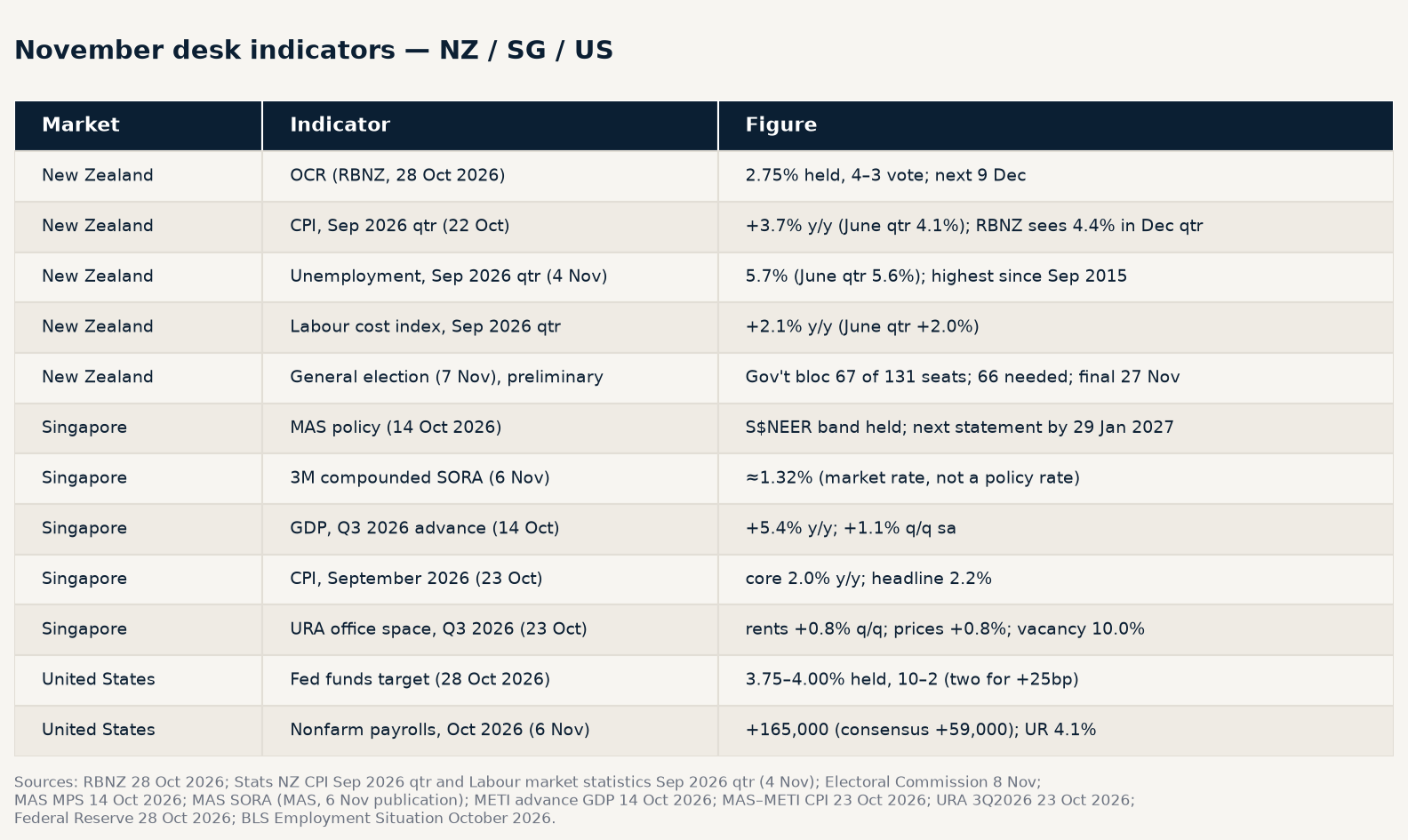
Source: RBNZ 28 Oct 2026 / Stats NZ CPI September 2026 quarter (22 Oct 2026) and Labour market statistics September 2026 quarter (4 Nov 2026) / Electoral Commission preliminary results 8 Nov 2026 / MAS Monetary Policy Statement 14 Oct 2026 / MAS SORA (MAS, 6 Nov 2026 publication) / METI advance GDP 14 Oct 2026 / MAS–METI CPI 23 Oct 2026 / URA 3Q2026 statistics 23 Oct 2026 / Federal Reserve 28 Oct 2026 / BLS Employment Situation October 2026.
7. Singapore Market Update / The Freehold Case
In New Zealand the case is income. In Singapore the case is capital preservation, at a lower income. Both are valid. The mistake is applying the same framework to both.
Zoning still decides which Singapore assets an offshore syndicate can buy at all. IRAS charges Additional Buyer's Stamp Duty (ABSD) on residential property: 60% for foreigners and 65% for entities. For a whole building with land, IRAS classifies the property by its Master Plan zoning, so land zoned "Commercial" counts as non-residential and attracts ordinary Buyer's Stamp Duty only, and the Singapore Land Authority confirms that a foreign person can buy commercial and industrial property without approval under the Residential Property Act. That is why both Singapore buildings featured this month are commercial. One caution carries over from October: land zoned "Commercial & Residential" is treated as part residential, and ABSD applies to the residential share, so the zoning line on any shophouse is the first thing to confirm.
The yield is not the pitch. CBRE's own comparison, as reported by EdgeProp on 21 October, is that freehold and 999-year conservation shophouses in Districts 1 and 2 have transacted at between S$16 million and S$22 million, or S$5,000 to S$6,800 per square foot, over the last six months. That is the scale of capital preservation being offered: a small plot, a tight Master Plan, and a market that has not stopped trading.
Featured Listings
These are not Fairhaven listings. They are three assets on the open market this month through other agencies, chosen because each is large enough to need pooled capital and each restates this edition's split: one New Zealand asset where the income is already in a lease with the Crown, and two Singapore commercial buildings where the case is the land and the tenure, not the yield. Fairhaven acts for the buyer. Eligible wholesale investors can ask us about any of them and register interest; we advise on the asset and on how an acquisition could be structured. All figures below are as published by the selling agent or in launch reports; we have not estimated values or yields. Deadlines: both Singapore expressions of interest close at 3pm Singapore time on Wednesday 25 November; the Mt Wellington deadline private treaty closes at 4pm on Thursday 3 December.
New Zealand
Mt Wellington, Auckland — 12–14 Lockhart Place, Crown-Leased Industrial Holding
On the market via Bayleys (Sunil Bhana, Scott Campbell, Charlie Tudehope, James Valintine), sole agency. Fairhaven: buy-side adviser and syndicate structurer.
| Property Type | Industrial: high-stud warehouse and office, all-weather canopy, yard and loading areas, 51 car bays, dual access and drive-around (built mid-1990s and subsequently upgraded) |
| Sale Method / Closing | Deadline private treaty, closing 4pm Thursday 3 December 2026 (unless sold prior). Price not stated. |
| Net Income (as published) | NZ$1,651,884 per annum + GST, net |
| Tenant / Lease | Fully leased to the New Zealand Government. The tenant has occupied since 2017 and has committed to a new nine-year term from September 2026 |
| Rent Reviews | Annual CPI reviews; three-yearly market reviews |
| Area | Approx. 7,339 sqm of building on a 1.4495 ha freehold site, zoned Business – Light Industry |
Notes: In Mt Wellington, with access to State Highway 1 and the wider arterial network, close to Sylvia Park (Bayleys, via OneRoof, 7 Nov). The department that holds the lease is not named in the marketing. Listing: https://www.bayleys.co.nz/listings/commercial/auckland/auckland/12-14-lockhart-place-mt-wellington-1907245
Investment Potential: The income case again, and a different kind of covenant from October's. A Crown tenant on a freshly renewed nine-year term, with annual CPI reviews, means the rent roll does not care whether 9 December is a rise or a hold, or how the special votes fall on 27 November. The ticket needs pooled equity, which is the part we structure. The risks are real and should be priced: a single tenant, a mid-1990s building that may need capital over a long hold, rental growth in the industrial sector that Bayleys itself describes as moderating, and review terms (any caps or floors on the CPI reviews) that the marketing does not publish. The land is the long-run value: 1.45 hectares of Light Industry in one of Auckland's tightly held precincts. The deadline is 3 December.
Singapore
Raffles Place — 15 Phillip Street, Ten-Storey Commercial Building
On the market via ETC (Swee Shou Fern, Poh Xiang Ting, Lee Zhanhui). Fairhaven: buy-side adviser and syndicate structurer.
| Property Type | Ten-storey commercial building; coffee shop on the basement, first and second storeys |
| Guide Price / Sale Method | S$91 million indicative asking price. Expression of interest closes 3pm Wednesday 25 November 2026. |
| Net Income (as published) | Not stated |
| Tenancy | Not stated beyond the coffee shop; other occupiers and lease terms not published |
| Area | Site approx. 358.3 sq m (3,857 sq ft) |
| Tenure / Zoning | 999-year leasehold from 25 January 1826 (near-freehold); zoned "Commercial", plot ratio 15, building height control above 50 storeys |
| Stamp Duty / Foreign Buyers | No ABSD and no restriction on foreign ownership (per the agent); outside the areas affected by URA's restrictions on strata subdivision of commercial space |
Notes: Surrounded by established Grade A and premium commercial buildings, near Raffles Place MRT (East-West and North-South lines) and Telok Ayer MRT (Downtown line). ETC says there is "hardly any" commercial stock available for sale below S$100 million in this location. Listing: https://etcsea.com/properties/15-Phillip-Street — report: https://www.newsflashasia.com/etc-lists-prime-raffles-place-building-for-s91m/
Investment Potential: The Singapore case, not the New Zealand one. What the buyer gets is a tightly held CBD site at a plot ratio of 15, with ABSD out of the structure, and the option, subject to approvals, of redevelopment or future strata sale. ETC has not published the income, so we cannot say what the asset pays; the first things to see are the tenancy schedule and the lease expiries. The tenure is a 999-year lease, which is near-freehold, not freehold, and the gap should be priced. A S$91 million ticket is the kind that needs a syndicate. The EOI closes on 25 November.
Central Area — 171 Telok Ayer Street, Freehold Conservation Shophouse
On the market via CBRE. Fairhaven: buy-side adviser and syndicate structurer.
| Property Type | Three-storey conservation shophouse with a mezzanine |
| Guide Price / Sale Method | S$23.76 million indicative (about S$5,700 psf on approx. 4,168 sq ft); expression of interest closes 3pm Wednesday 25 November 2026 |
| Net Income (as published) | Not stated |
| Tenancy | Fully occupied: F&B operator on the ground floor, office occupiers above. Lease terms not stated |
| Area | Commercial plot approx. 1,390 sq ft; total floor area approx. 4,168 sq ft |
| Tenure / Zoning | Freehold; described by the agent as a commercial plot in the Telok Ayer Conservation Area. Master Plan zoning to be confirmed against URA before any ABSD statement is relied on |
Notes: Within walking distance of Telok Ayer (Downtown line), Tanjong Pagar (East-West line), Shenton Way and Maxwell (Thomson-East Coast line) stations. CBRE says the upper floors could potentially be converted to restaurants, wellness facilities or serviced apartments, subject to approval, and that it expects interest from corporate investors, family offices and high-net-worth individuals at a quantum under S$25 million. Launch report: https://www.edgeprop.sg/property-news/freehold-telok-ayer-street-conservation-shophouse-hits-market-2376-mil
Investment Potential: The scarcity case in its smallest form. A single freehold shophouse at under S$25 million is a ticket a family office can write, and at S$5,700 psf it sits inside the S$5,000 to S$6,800 psf band that CBRE says comparable conservation shophouses have traded in over the last six months. The risks are those of any small, tightly zoned asset: one building, a conservation envelope that limits what can be done to it, an income the agent has not published, and any change of use putting a residential question, and a 60% or 65% ABSD, back on the table. Confirm the zoning and the approved use first. The EOI closes on 25 November.
For more info on any of the above listings, or to register interest, contact the Fairhaven team directly. Agent deadlines: 3pm Wednesday 25 November (15 Phillip Street and 171 Telok Ayer Street) and 4pm Thursday 3 December (12–14 Lockhart Place).
Petrus Yen — Petrus@fairhavenproperty.co.nz
Shann Chen 陈珊 — shann@fairhavenproperty.co.nz
Disclaimer: The information provided is based on publicly available data and internal analysis. For informational purposes only. Not financial, legal or tax advice. The featured properties are marketed by the agencies named; details are as published by those agencies and may change or be withdrawn without notice. Property details and projections are indicative only. Readers should conduct independent due diligence, including on stamp duty and foreign-ownership rules, before making any investment decisions.
Fairhaven Property Group specializes in real estate investment opportunities across New Zealand, tailored specifically for wholesale investors as defined by the Financial Markets Authority (FMA). Please note, our offerings are not available to retail investors. For more information on what constitutes a wholesale investor, please visit the FMA's guidelines. Individuals who are tax residents outside of New Zealand are hereby advised to procure legal counsel or engage with the appropriate regulatory authority to assess their eligibility for investing with our entity, contingent upon their residency status.